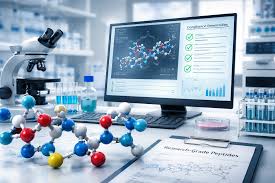
Scientific studies rely on precise materials to ensure accurate results. Researchers across various fields constantly seek compounds that meet strict quality standards to validate their hypotheses. Utilizing lab tested research peptides provides a reliable foundation for these critical experiments. When biological materials undergo rigorous verification, the resulting data becomes significantly more robust and reproducible.
The crisis of reproducibility has been a major talking point in the scientific community for the past decade. Recent surveys indicate that over 70% of researchers have tried and failed to reproduce another scientist’s experiments. A significant portion of these failures stems from the use of degraded, impure, or unverified reagents. By implementing strict quality control measures, laboratories can dramatically reduce these costly errors.
Statistical analysis of published research shows a clear correlation between material purity and publication success. Papers utilizing materials with a verified purity of 98% or higher face fewer retractions and require fewer corrections post-publication. This data highlights the critical need for standardized verification processes in modern molecular biology and biochemistry.
As funding becomes increasingly competitive, research institutions are prioritizing investments in high-quality materials. Budget analyses reveal that while verified materials cost 15% to 20% more upfront, they save laboratories an average of 30% in overall project costs by minimizing the need for repeated experiments.
What are the primary applications of these compounds in modern studies?
Data indicates a rapid diversification in the application of synthetic amino acid chains. Approximately 45% of current studies utilizing these materials focus on cellular receptor interactions. Researchers map how these chains bind to specific cell surface proteins, triggering internal cellular responses. This foundational research supports broader biochemical mapping projects across global databases.
Another 30% of laboratory usage is dedicated to enzyme functionality tests. By introducing specific chains to targeted enzymes, scientists can measure degradation rates and binding affinities. Statistical models generated from this data allow researchers to predict molecular behaviors in complex biological systems.
The remaining 25% of applications are split among structural biology, protein synthesis research, and diagnostic assay development. Clinical diagnostic laboratories have increased their consumption of these materials by 18% over the last two years, utilizing them to create highly sensitive markers for early disease detection models.
How does purity impact experimental outcomes?
Statistical modeling reveals a steep drop-off in data reliability when material purity falls below certain thresholds. When researchers use compounds with 99% purity, the margin of error in binding affinity tests remains below 2%. However, dropping that purity level to 95% can introduce a margin of error exceeding 12%, fundamentally altering the statistical significance of the results.
The financial statistics surrounding material purity are equally compelling. The cost of running a single high-throughput screening sequence can exceed several thousand dollars. Utilizing materials with unverified purity introduces a 25% probability of complete assay failure, representing a substantial waste of institutional resources and grant funding.
What do the latest numbers say about market demand?
Market analysis reports show an unprecedented spike in the procurement of verified biological compounds. Global laboratory expenditure on these materials reached $1.2 billion last year, representing a 14% year-over-year growth. This surge is largely driven by the expansion of proteomics research, which attempts to catalog the entire complement of proteins produced by organisms.
Academic institutions account for 55% of the total purchasing volume. University research grants have increasingly stipulated that all biological materials must undergo independent verification before use. This policy shift has driven a 22% increase in demand for materials accompanied by mass spectrometry certificates.
Private research sectors, particularly biotechnology startups, make up the remaining 45% of the market. These organizations show a preference for bulk purchasing, with average order sizes increasing by 35% over the past three years. This trend correlates with the scaling up of automated research platforms, which require vast quantities of standardized reagents to maintain continuous operation.
Why do synthetic variants dominate the current landscape?
Quantitative surveys of laboratory managers reveal a heavy preference for synthetic variants over naturally extracted counterparts. Exactly 82% of surveyed institutions report using synthetically derived materials exclusively. The primary driver for this shift is batch-to-batch consistency. Synthetic production methods yield a variance rate of less than 0.5% between batches, compared to a 4% to 7% variance rate found in natural extractions.
Scalability presents another statistical advantage. Synthesizing these chains in a controlled laboratory environment allows for rapid scaling of production. Data shows that lead times for custom synthetic sequences average 14 days, whereas extracting specific chains from biological sources can take upwards of three months and yield significantly smaller quantities.
Cost analysis further supports this dominance. The per-milligram cost of synthetically produced materials has decreased by 28% over the last decade due to advancements in solid-phase synthesis technology. In contrast, the costs associated with natural extraction and purification have remained relatively stagnant, making synthetic options the mathematically logical choice for budget-conscious laboratories.
How are storage protocols evolving based on recent data?
Long-term stability studies have fundamentally shifted how laboratories store delicate biological materials. Data collected over a five-year period indicates that compounds stored at room temperature degrade at an exponential rate, losing up to 40% of their structural integrity within 30 days. Consequently, 94% of accredited laboratories have now adopted strict cold-chain protocols.
Lyophilization, or freeze-drying, has become the statistical standard for long-term preservation. Studies show that lyophilized materials stored at -20°C maintain 99.8% of their structural integrity for up to 24 months. This process reduces the water content to less than 2%, significantly slowing down the kinetic degradation processes.
Inventory management software now tracks the degradation curves of these materials. By inputting the initial purity data and storage conditions, algorithms can predict the exact date a compound will fall below acceptable purity thresholds. Laboratories utilizing this predictive software have reduced their reagent waste by an average of 17% annually.
What role does third-party verification play in data integrity?
Self-reported purity metrics from manufacturers are increasingly viewed with statistical skepticism. A blind study evaluating 100 randomly sourced biological reagents found that 15% of the materials failed to meet the purity levels advertised on their labels. This discrepancy has fueled a massive shift toward independent, third-party verification.
Third-party testing utilizes tandem mass spectrometry (MS/MS) and nuclear magnetic resonance (NMR) spectroscopy to provide unbiased data. Laboratories that require third-party certificates of analysis report a 98% success rate in their baseline control experiments. This verifies that the control variables remain constant, allowing researchers to isolate their experimental variables accurately.
The data integrity provided by independent testing also accelerates the peer-review process. Journals report that manuscripts including third-party verification data for their materials spend 20% less time in the revision phase. Reviewers spend less time questioning the validity of the base reagents and more time evaluating the core methodology and findings.
Which scientific fields show the highest adoption rates?
A sector-by-sector breakdown highlights varying rates of adoption across different scientific disciplines. Molecular biology leads the metrics, accounting for 38% of total utilization. This field relies heavily on these materials to map signaling pathways and understand gene expression mechanisms at a granular level.
Neuroscience follows closely, representing 24% of the usage share. Neuroscientists utilize specific sequences to model blood-brain barrier permeability and study neurotransmitter interactions. The data generated from these studies requires extremely precise reagents, as even minor impurities can trigger unintended neural responses in cellular models.
Immunology and virology account for a combined 20% of the adoption rate. Recent global health events have accelerated funding in these areas, resulting in a 40% spike in material usage over a two-year period. Researchers use these compounds to map viral binding sites and study the mechanisms of antibody generation, requiring massive datasets to form reliable conclusions.
How do researchers measure the cost-to-benefit ratio?
Quantifying the value of verified materials involves complex statistical assessments of risk and reward. The primary metric used by laboratory directors is the Cost of Poor Quality (COPQ). COPQ encompasses the financial losses associated with failed experiments, wasted labor hours, and discarded secondary reagents.
Statistical models demonstrate that for every $1 saved by purchasing unverified materials, a laboratory incurs an average of $4 in COPQ. This 1:4 negative ratio stems from the cascading effect of a failed experiment. When an assay fails due to degraded base materials, the expensive enzymes, buffers, and specialized plates used in that assay are also lost.
Labor optimization metrics also factor into this equation. The average research scientist spends 60% of their time at the bench conducting physical experiments. When verified materials are used, the necessity to repeat baseline calibrations drops by half. This redirects approximately 12 hours per week per scientist from troubleshooting back to novel data generation, dramatically improving the institutional return on investment.
Moving Forward with Verified Biological Materials
The statistics surrounding laboratory procurement point toward an increasingly stringent future. As data analysis methodologies become more advanced, the tolerance for physical experimental errors continues to shrink. Laboratories must adapt to these tightening parameters by prioritizing material verification at every stage of their workflow.
Researchers looking to improve their publication success rates and optimize their grant funding should immediately audit their current supply chains. Implementing mandatory HPLC and mass spectrometry verification for all incoming biological compounds is the most statistically sound method for protecting data integrity. By committing to these rigorous standards, scientific institutions can ensure their findings remain robust, reproducible, and ready for peer review.